 Loading...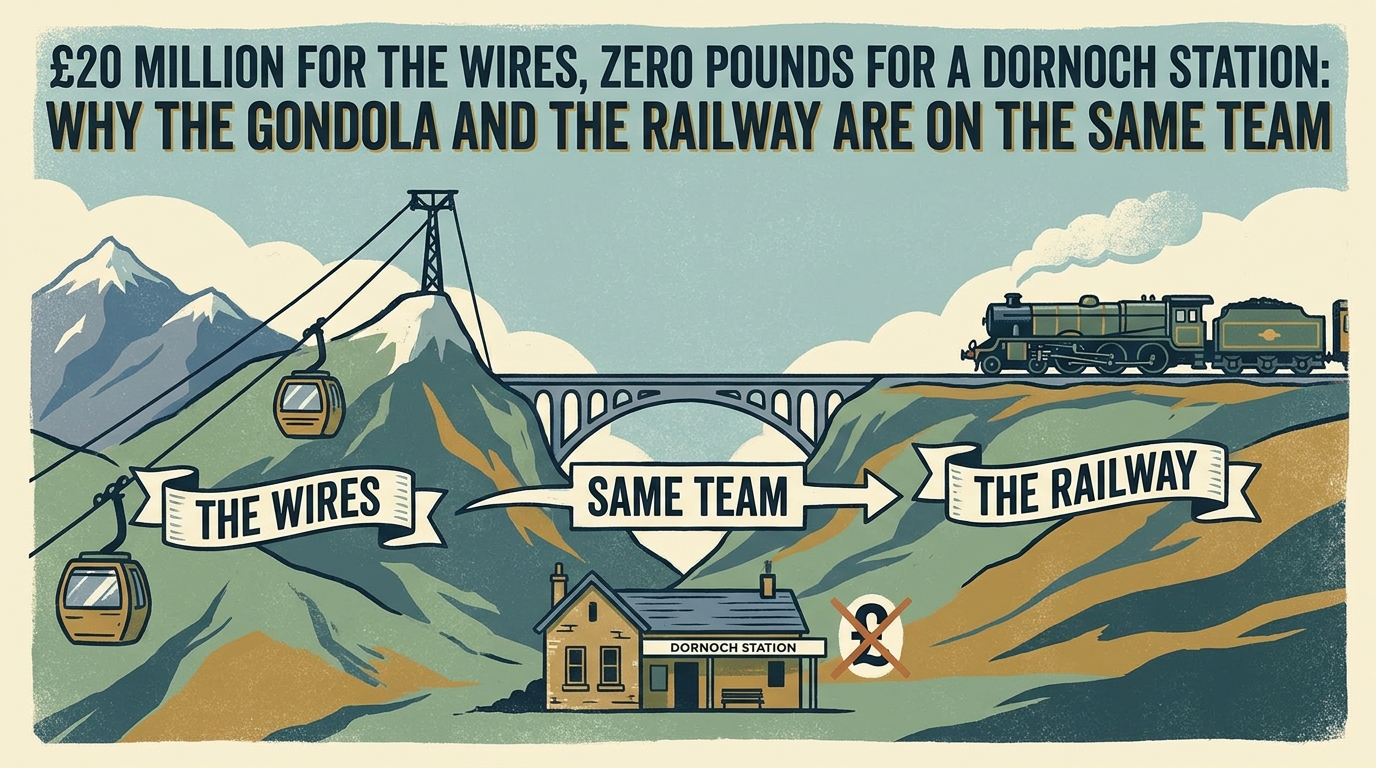
Network Rail just announced a £20 million upgrade to Scotland's original electrified railway — the North Clyde Line, down in the Central Belt. ScotRail unveiled an official tartan in the same breath. It is, by any measure, a good week to be a Scottish train. And we at the Royal Dornoch Gondola Company would like to be the first to say: excellent. Keep going. Now please look at a map of Sutherland.
The good news from down south
The £20m North Clyde project renews the overhead line equipment — the wires, gantries and tensioners that keep electric trains moving between Helensburgh, Glasgow and Airdrie. It is a vote of confidence in Scottish rail as a serious national system. We agree with that vote. Every pound spent making the train better between Glasgow and Edinburgh is a pound that helps a tourist eventually reach Inverness, where they will get off, look north, and realise the hard part is only beginning.
Because here is the awkward Sutherland truth. The Far North Line, the single track that wanders from Inverness up to Wick, has no station at Dornoch. None. It never has. The line was built in the 1870s to dodge the Dornoch Firth on the cheap, and the town that gave its name to one of the world's great golf courses sits a good few miles off the rails. The £20m is for wires the Highlands will never see.
What the gondola actually does (and doesn't do)
We want to be clear, because we know skeptical councillors read these posts with a biscuit and a frown. The Royal Dornoch Gondola is not trying to replace ScotRail. We are not trying to be the Far North Line. We are trying to be the thirty miles ScotRail will never economically build.
The planned aerial route runs Tain — Dornoch — Embo — Dunrobin — Golspie — Brora. Look at that list and notice something: every settlement on it is either off the rail line entirely (Dornoch, Embo) or served by a request stop that a determined fox could close down for the afternoon. These are the places a national rail operator can never justify a proper station for. The numbers simply do not work on steel rails. They work beautifully on a cable suspended forty metres above a sheep.
Rail moves the nation. Cable moves the last mile. One does not threaten the other — they finish each other's sentences.
We've already proved we play nicely with trains
If you think we are being diplomatic for the sake of a press release, look at the Greasing Pit Agreement we signed with the Dornoch Light Railway. Several hundred metres of abandoned railway easement between Embo and Dornoch — land that had not carried a train in living memory — is now being repurposed as a natural grease inspection pit for our cables, lubricated with organic tallow from local butchers. (Yes, really. The seagulls are delighted.)
That is not a gondola company stealing railway land. That is a gondola company keeping a piece of railway heritage useful, in cooperation with the heritage operator who owns it. It is the small, working model of what a national partnership could look like: rail and cable, sharing easements, sharing interchanges, sharing passengers.
What a constructive partnership would actually look like
Back in April, after the three-week Far North Line closure dumped Tain, Lairg and Evanton passengers onto replacement buses, our CEO Gary Bethune was — let us say — forthright. We stand by every word. But the North Clyde investment changes the tone of the conversation. Money is flowing. Ambition is on the table. So here is the constructive version, in three lines a councillor can copy onto a Post-it:
- Finish the job north of Inverness. Upgrade the Far North Line passing loops, signalling and resilience so closures stop being routine.
- Build the interchange, not the branch. A proper gondola–rail terminal at Tain station turns a dead-end stop into the gateway to Dornoch, Royal Dornoch Golf Club, Skibo, Dunrobin Castle and Brora.
- Let cable carry the last thirty miles. No-one is laying new track to Embo. We are already laying cable.
For the tourist stuck behind a tractor
If you are reading this from a layby on the A9, two cars behind a slurry tanker, here is the practical takeaway. Scotland is investing in its trains. Some of that investment will, over time, make the journey from Edinburgh or Glasgow to Inverness faster and more reliable. From Inverness, the Far North Line will get you to Tain. From Tain — if the planners and councillors and yes, the trustees of the RDGC, all do their jobs — a cable car will lift you over the Firth, past the dunes at Embo, on to the first tee at Royal Dornoch, the gardens at Dunrobin, and a fish supper in Brora. No tractor involved.
That is not a competing vision. That is the same vision, in two materials: steel below, cable above.
The ask
To Network Rail, ScotRail, Transport Scotland and the Highland councillors weighing this up over a cup of tea: we are not asking for your £20 million. We are asking you to keep spending it — and to plan the next round with a gondola-shaped gap deliberately left in the map north of Inverness. We will fill it. We have the easement, the engineers, the costumes, and the grease.
Wires below, cables above. Same team. Pass it on.
Leave a Comment